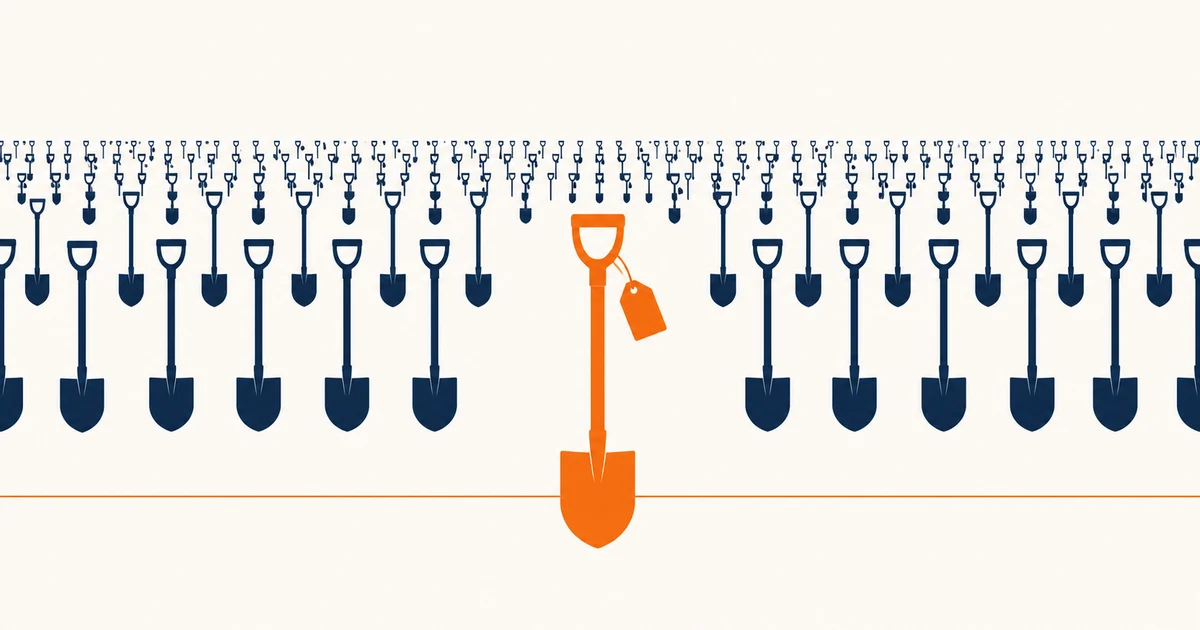
In May 1848, Sam Brannan walked through the streets of San Francisco waving a vial of gold dust. "Gold! Gold from the American River!" He hadn't found the gold and never dug for any. What he had done was buy up every pickaxe, shovel and pan in town the week before. The pans cost him twenty cents. He sold them for fifteen dollars and made 36,000 dollars in nine weeks.
Brannan never went digging because he knew where the money was. The money is with the people selling the gear.
The big fortunes of the California gold rush almost never went to the prospectors. They went to the suppliers. Brannan with his pickaxes and pans, and later real estate. Levi Strauss with his workwear for miners. The traders selling food, tools and land to the thousands who showed up to dig. There's even a name for it that stuck: the pick-and-shovel play [6]. Sell the shovels to a booming business and you win no matter what.
Scroll your Facebook or LinkedIn feed for ten minutes today and you'll spot the modern shovel-sellers. AEO, GEO, "LLM optimization", "AI visibility". Someone talking into the camera about a tool that doubled their revenue. An ad dressed up as a news article. A graph shooting up. A counter telling you how many competitors are already ahead of you.
Same gold rush. Same dynamic.
And the question is the same one as in 1848: how much of this is real, and if I go digging, is there any guarantee I'll find anything?
What is AEO or GEO (generative engine optimization)?
AEO stands for answer engine optimization, GEO for generative engine optimization. Both are about the same thing: showing up in the answers of AI tools like ChatGPT, Gemini, Claude or Google's AI Overviews, and not only in the classic search results.
AEO is the older term. It appeared when Google started answering questions directly, in featured snippets and through voice assistants. GEO was added in 2023, when researchers began measuring which sources generative AI models cite. In practice the two are used interchangeably, and usually sold as something entirely new. How new it is, that's what the rest of this piece is about.
Why everyone is selling shovels right now
A gold rush pulls in two kinds of people. The ones who believe they'll get rich, and the ones who make money off that belief. AEO and GEO are no different.
It starts with a concept that sounds real enough to take seriously but stays vague enough that you can't argue with it. There's a real core to it: AI models pick their information differently than Google does.
But that real core is exactly what feeds the rush, because you can't just call it nonsense. And if you've never heard of it, which is most business owners, there's no way to tell what's legit and what isn't.
That's why the sellers are such a mixed bag. On one end, brand-new tools on a six-month-old domain with a suspicious 4.9 on Trustpilot. On the other, established SaaS companies that repackaged what they already had. The same directory syndication they sold as "local SEO" for five years is now "LLM optimization". The product barely changed; the wrapper just fits the hype better. The pressure to get "AI" into your pitch is enormous, from investors, from sales, from competitors already doing it.
Roughly, there are three kinds of tools. Ones that automate existing SEO, ones that monitor your AI visibility, and ones that promise a full strategy. That split tells you almost nothing about how honest the marketing around them is. All three categories hold solid products with false promises and weak products with false promises. The type of product isn't the dividing line.
And the manipulative framing isn't limited to the obvious cottage-industry scammers. Companies with a decent product reach for it too, because it converts. So the line isn't "trustworthy company versus scammer". It's "verifiable claim versus empty promise", whoever is making it.
The playbook: how the shovel-sellers lure you to the river
Step 1: Gold! The longer you wait, the more you lose
Brannan didn't sell shovels by explaining what a shovel does. He ran down the street shouting that there was gold.
The modern version: skip explaining what the tool does. Just shout that your competitors are getting rich while you sit still.
Classic marketing solves a need you already have. Sometimes it shows you a need you didn't know about. This marketing does something else. It manufactures the fear first. It works in two moves. First, the news that everyone else is already onto something you haven't started. Then the guilt of being the one who's behind.
"While you're reading this, your competitors are already getting mentioned by ChatGPT. Every day without AI visibility is a day they're taking your customers."
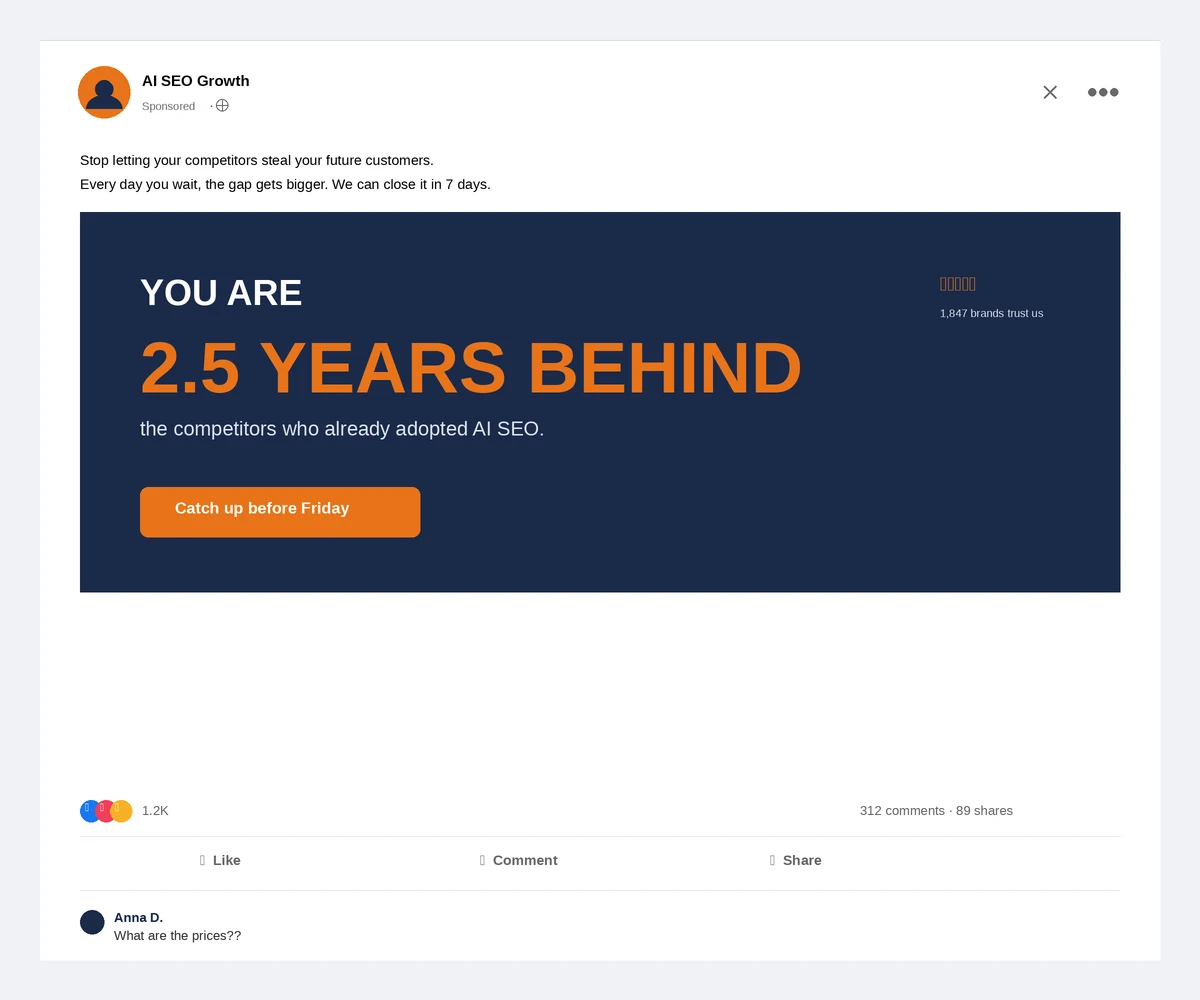
A real one I came across: "You are 2.5 years behind the competitors who have already adopted AI SEO." That 2.5-year figure is invented out of thin air. Nobody asks where it comes from, because the shame lands faster than the skepticism.
An established player does the exact same thing, just dressed up better: "AI doesn't show a list of links. It picks one brand to recommend. If yours isn't LLM optimized, you're invisible." "Invisible" is the lever. And the claim that AI "picks one brand" is a stretch. AI assistants usually name several sources, change their answer per question, and factor in your conversation history.
It works well with AI because the tech moves fast enough that the fear feels plausible. Nobody knows what "doing AI right" even means. I feel it myself, like I wrote in another piece, when I read the business press or scroll LinkedIn. That's the kind of fear you can't argue your way out of.
Step 2: these people got rich finding gold
Once the fear is planted, it needs proof. That comes as numbers and graphs that look convincing and say almost nothing.
The graph with the kink. Flat line on the left, sharp climb on the right, an arrow and "Tool X started" stuck on top. What you don't get to see: which metric this is, over what period, whether the site was simply brand new. Every new site grows at the start, whatever tool you use. The graph implies cause and effect. All it proves is that a line went up at some point.
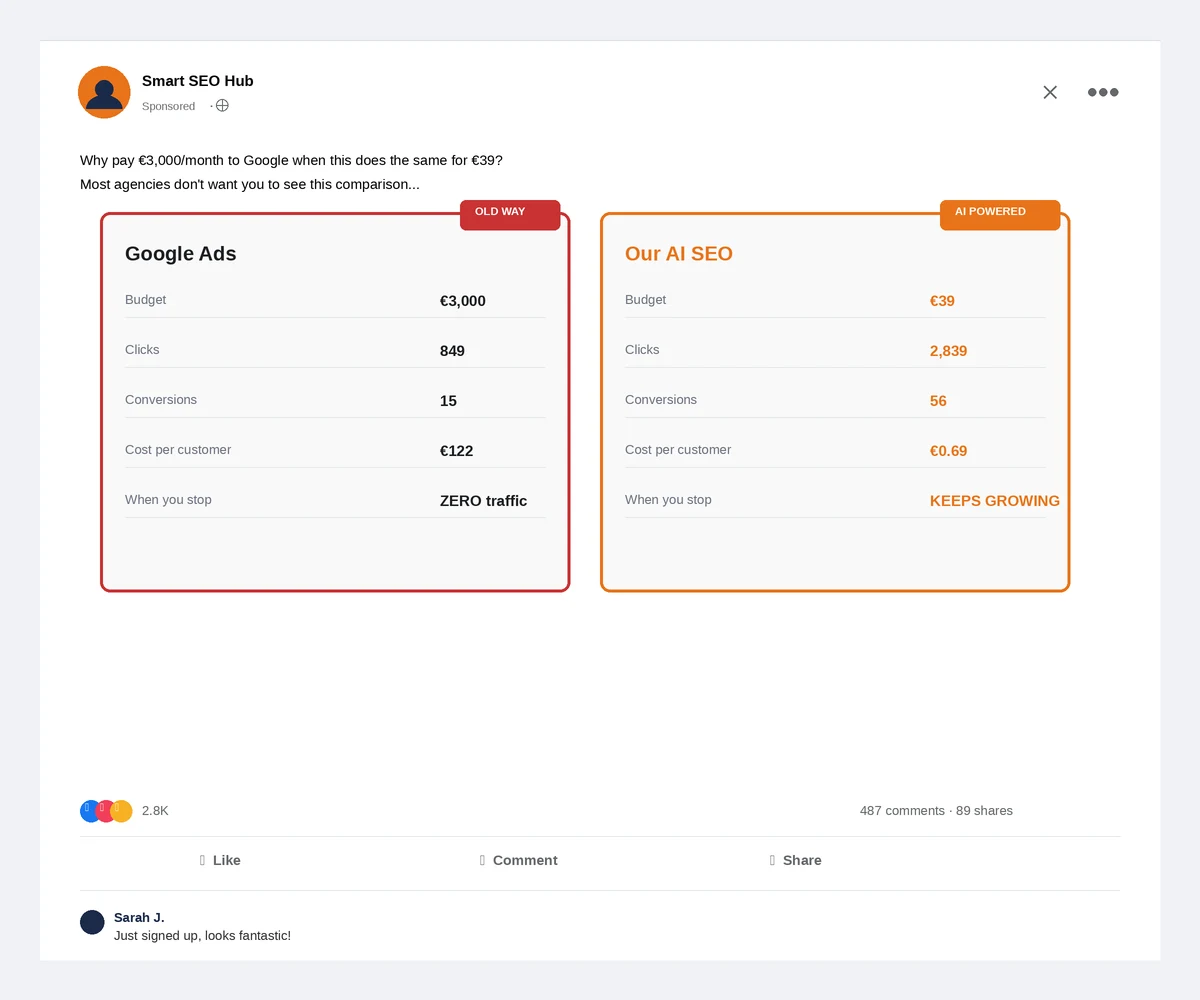
The apples-to-oranges comparison. As a performance marketer this one makes me wince. Two columns side by side, the supposedly expensive old way on the left, the cheap new way on the right. A real ad I came across: two receipts, "Google Ads" on the left, the SEO tool on the right.
Google Ads, Budget: €3,000, Clicks: 849, Conversions: 15, Cost per customer: €122, Traffic when you stop: ZERO
The tool, Budget: €39, Clicks: 2,839, Conversions: 56, Cost per customer: €0.69, Traffic when you stop: KEEPS GROWING
Putting a €3,000 ad budget next to a €39 software subscription isn't a comparison. The ad budget is the traffic you're buying. The €39 just gets you into the tool; the content, the time, the waiting for results aren't in that number. And those 2,839 clicks, where are they from? Are they just scooping up brand search from people already looking for your name? The idea that an SEO tool pulls in non-branded keywords at a higher conversion rate than paid search is a joke on its own. And the whole AI shift is busy eating into organic clicks anyway, with all the no-click searches Google's own AI answers now produce.
Volume as a quality signal. "30 SEO articles a month. 15 backlinks a month. Fully on autopilot." Sounds concrete. But 30 AI-written articles a month on a site Google already distrusts isn't a fix, it's fuel on a fire that's already smouldering. And the backlinks, from which sites, with what authority? Then comes the obligatory review: five stars, from someone whose background says nothing about what you'd get.
Step 3: make sure it doesn't look like selling
Brannan ran into the street himself with the vial. Just a guy, like you. Not a salesman.
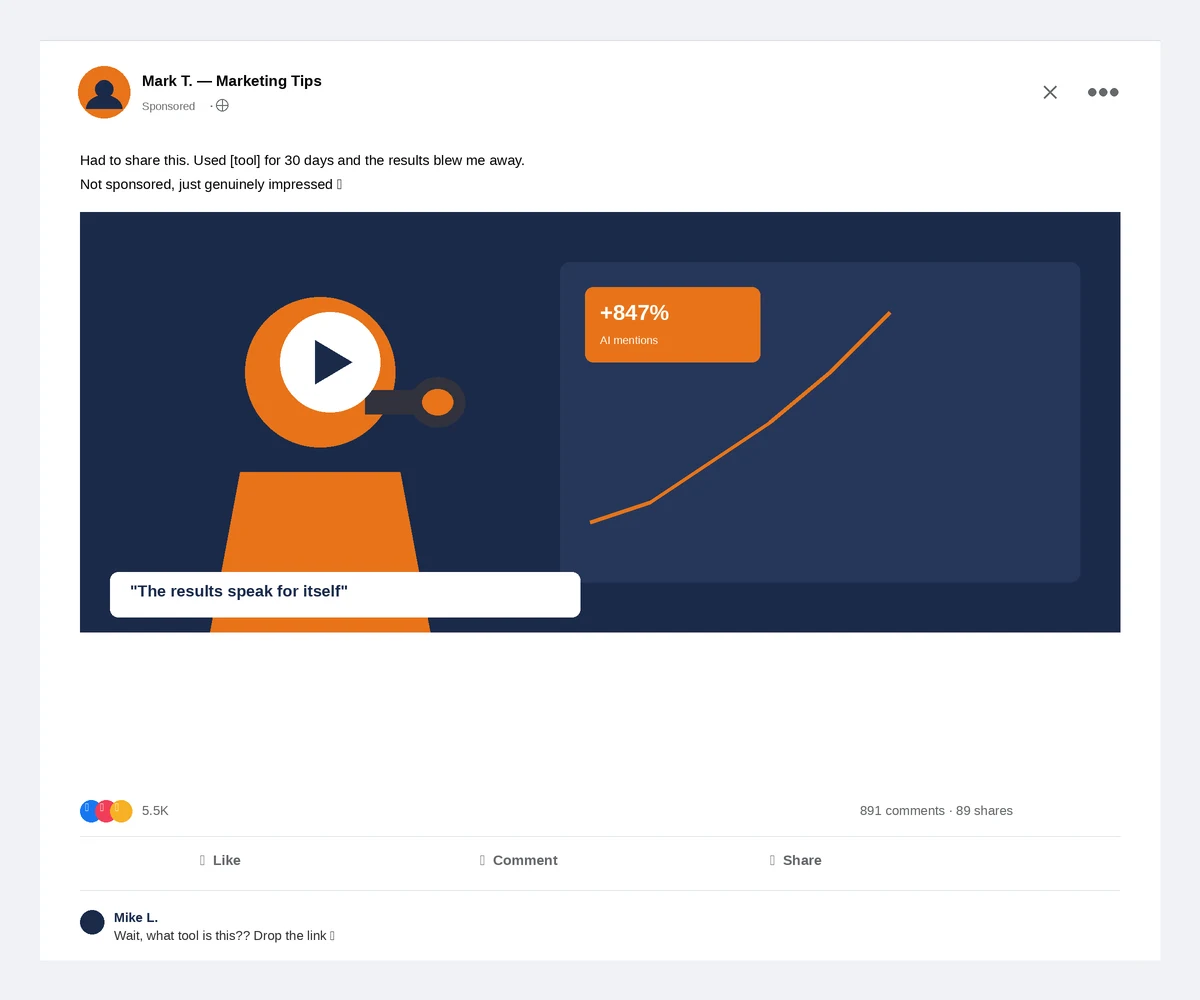
A format you see everywhere now: someone, often holding a mic, talks straight into the camera, casual, with a graph or dashboard behind them. "The results speak for itself." It looks like a TikTok of someone sharing a find. It's a produced ad with a cherry-picked graph and a call to action. That casual, non-salesy format is exactly what switches off your guard. You take it as a tip from someone you know, not a pitch.
Same with the fake news article that looks like an editorial in a real newspaper: "X cracks the code for AI visibility." There's no clear ad label, and it has every visual signal of a real journalist writing it. And the influencer version: a known name posts "Had to give this a try!" with "paid partnership with [brand]" in small print underneath. It reads as a personal recommendation. That credibility was bought.
Step 4: let the crowd do the work
When half of San Francisco took off for the river, that was the proof. People follow people.
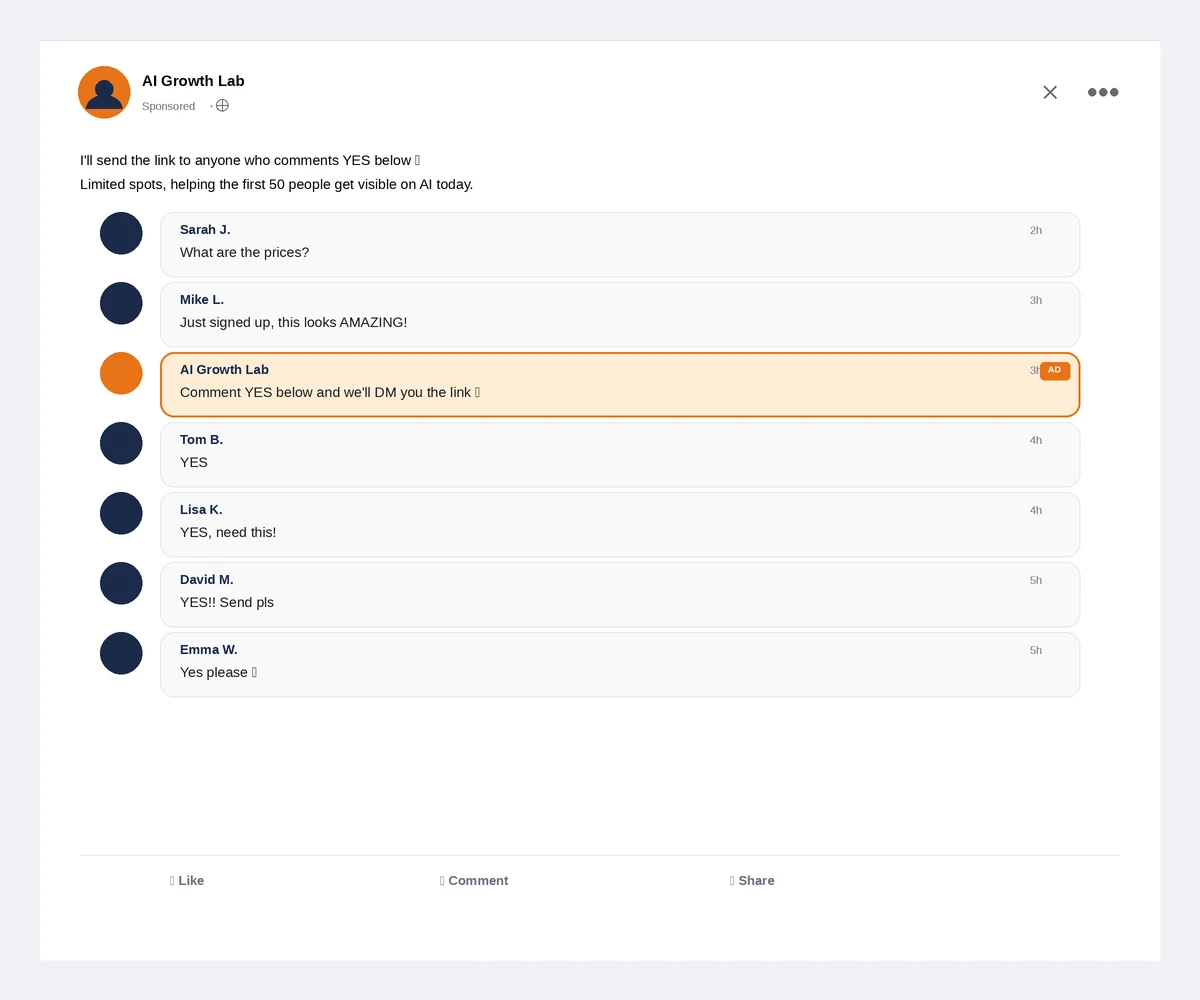
There are always comments under these ads. "What's the pricing?" "Just signed up, looks amazing." Those comments are part of the ad. To anyone scrolling, they read as social proof. A common one is "Comment 'YES' and I'll DM you the link." That's not a service. Every comment pushes the post further in the algorithm. You're spreading the ad while you think you're asking for a discount.
Emotion gets used too, not always fear. Sometimes it's recognition:
"Got quoted €3,200/month by a marketing agency. For my local shop. I almost laughed. So I did it myself with [tool]. A whole year costs less than one month of their quote."
You don't think "they're selling me something", you think "this is someone like me". But the evidence is just as absent: the quote can't be checked, the comparison is with an agency that never did the work, and there are no real results anywhere.
The parallels at a glance.
| Gold rush (1848-1855) | AEO/GEO rush (now) | |
|---|---|---|
| The bait | "Gold from the American River!" Shout that the riches are there and that others are already grabbing them. | "Your competitors are already getting mentioned by AI." Shout that the traffic is there and you're missing out. |
| The urgency | Show up late and there's nothing left. Everyone's leaving now. | "You're 2.5 years behind." Every day you wait costs you customers. |
| The proof | A vial of gold dust held up in the street. One visible sample for an invisible promise. | The graph with the kink, the receipt comparison. One visible number for an unverifiable claim. |
| The product | Pickaxes and pans worth 20 cents, sold for 15 dollars. | A €39/month subscription that does "weeks of work in 3 minutes". |
| The packaging | Brannan in the street, hat in hand: a guy with a story. | The talking head straight into the camera, the fake news article, the paid influencer. |
| The social proof | Half the city heads off; the crowd is the argument. | Comments under the ad, "comment YES for the link", the crowd is the argument. |
| Was there gold? | Yes, real gold. Far less of a sure thing than it looked. | Yes, really. Far less of a sure thing than it looks. |
| Who won for sure | The suppliers. Brannan, Levi Strauss, the people selling land and food. | The SaaS companies and the marketers, whether you get results or not. |
| The endgame | The coast littered with hundreds of abandoned, identical mining gadgets. | Hundreds of near-identical AI tools, most on the digital scrap heap within two years. |
Was there actually gold?
Here the honest story gets messier than "it's all a scam", because it isn't.
In 1849 there really was gold in those rivers. Men pulled nuggets out of them. But the myth that everyone came home broke isn't true either. After costs, a share of the prospectors still turned a modest profit. The truth sits in the middle, which makes it less dramatic than either extreme.
Same with AEO and GEO. There's a real shift happening in how people find information. Visibility in AI answers is going to matter, and businesses that handle it sensibly get an edge. There's gold. Just a lot less of it, and a lot harder to dig out, than the shovel-sellers want you to think.
And there's a warning in the history that fits almost too well. Plenty of would-be entrepreneurs sailed to San Francisco in 1849 with their own invented mining gadgets, sure they'd sell them for a fortune. They got there and found the shoreline buried in hundreds of identical contraptions, dumped on an overflowing scrap heap. That's where the AEO tool scene lands within two years. Hundreds of near-identical tools, most of them scrap.
What it costs if you don't find the gold
The upfront damage is rarely the worst of it. These tools usually don't cost much.
What does more harm is the false sense that it's handled. A lot of owners don't know where their leads or conversions come from in the first place, as I wrote about in the subjective illusion of being data-driven. Someone switches on a tool like this and assumes the marketing is sorted. I see claims like "I replaced my marketing agency with this one tool". They check out of the work that would help. The tool pushes thirty articles a month, the dashboards go green, and maybe organic visibility grows. Probably it doesn't.
That last bit isn't a hunch. Since March 2024 Google has had a spam rule called "scaled content abuse": mass-producing pages mainly to push rankings instead of helping anyone. The part these tools skip over is that the rule targets churning out content with no value, whether a machine wrote it, a person did, or both. AI is a means, not the focus [1].
And the enforcement keeps tightening. The big August 2025 spam update ran almost four weeks; 2026 brought faster ones in March and again in June [2]. Google's spam system SpamBrain gets tuned constantly. The bigger one: in May 2026 Google pulled AI in by name. "Attempting to manipulate generative AI responses in Google Search" now counts as spam, the first time AI manipulation got named directly, and the tactics that try to force you into AI Overviews now carry the same demotion risk as old-school ranking spam [3]. Which is exactly what a lot of these tools are selling.
And the line they use, "but our content ranks fine, so we're good", doesn't hold up. Google judges the whole site, not page by page. Too much junk drags down how it sees everything you publish. Ranking well can even be the thing that triggers a manual action [4].
On top of that, there's the opportunity cost. The time, money and headspace you sank into the wrong tool could have gone somewhere that worked.
And it does something to the whole market. Once enough tools promise that pasting in a URL equals a marketing strategy, that becomes the benchmark. "Why am I paying you when this exists for €39 a month?" Fair question, if you're the one who can't see the difference, because you're not in this world. And plenty of owners have already been sold a story by a marketer before.
SEO, content and AI visibility aren't switches you flip on and off. They're things you build, and they need time and consistency. Stop and restart and you lose ground. Bet on a shortcut that doesn't work and you lose time.
Naive or calculated?
Both, probably, but not in equal parts. Most of these tools do something. On a new site in a low-competition niche they can even show results for a while. That gives you a handful of success stories, paraded around as if they apply to everyone. You only ever see the wins, never the cases where it flopped, and the tool already cashed the cheque. The incentive ends at the sale. The marketing around it, though, is deliberate. "Replace your marketing team with this one AI tool" is not a sentence anyone writes by accident. Sure, you'll cut costs. You'll also shoot yourself in the foot, because you don't buy a plane without someone who can fly it, unless you can fly it yourself.
So what does work?
If there's gold, how do you dig it out? The honest answer is duller than a subscription. AI visibility is mostly just good SEO plus a few things you should be doing anyway. Your page has to be readable to a machine, because a model that can't read you won't quote you. You answer real questions plainly, because that's what an AI lifts. You make it clear who you are and what you do, so a model knows it can trust you.
This isn't a gut feeling. A May 2026 analysis by Cyrus Shepard weighed 23 factors across 54 studies and found that classic search rank was the second-strongest predictor of whether an AI cites you, behind only whether your page is technically reachable [5]. Put differently: good SEO basically is your AI visibility.
None of that is a trick you buy off with one tool that fills in your URL. It's work, it pays off over months, and that's simply less exciting than a tool that says it'll do it all for a few euros a month.
What to ask before you choose a tool
1. How do they measure the result, exactly? "More mentions in AI", in which tool, on which questions, against what, over what period? No straight answer means an empty promise.
2. What are they comparing? Every graph and every before-and-after has a context: which metric, which window, what else moved at the same time? No context, no comparison worth anything.
3. Does their example fit your situation? A serious provider can tell you what they do, why it should work and where it can go wrong. Are you sure the mega-success they're showing maps onto your business at all?
An honest note
I'm not writing this from a neutral spot.
As a marketing consultant I recently picked up two leads who'd decided GEO or AEO had to be their top priority, after they started worrying about whether AI was mentioning them at all. Whether that came from ads like these or from claims by some agency, I'll leave open. Those conversations are useful to me. I get to explain what's real and what isn't, and from there have an honest talk about what would help. So yeah, I profit indirectly from the same machine I'm picking apart here.
Because honest marketing rarely stands out by what it sells. It stands out by how transparent it is about what it doesn't. Being straight, and not overselling, is what has served me in the long run.
- Google Search Central, "What web creators should know about our March 2024 core update and new spam policies" (March 2024). developers.google.com
- Overview of recent spam updates (August 2025, March 2026, June 2026), Search Engine Roundtable. seroundtable.com
- On 15 May 2026 Google clarified that its spam policy also covers "attempting to manipulate generative AI responses in Google Search". Google Search Central, "Spam policies for Google web search" and Search Engine Land, "Google updates search spam policies to clarify it applies to generative AI responses" (15 May 2026).
- Google Search Console Help, "Manual Actions report", on site-wide assessment: too much spam content affects the overall assessment, reputation and ranking of a site. See also Google Search Central, "Spam policies for Google web search".
- Analysis by Cyrus Shepard (May 2026) weighing 23 factors across 54 studies, which found that classic search ranking predicted AI citation at 9.4 out of 10, the strongest predictor after URL accessibility. Reported by Winbuzzer.
- Pick-and-shovel play: instead of betting on the winners of a hype, you make your money from the suppliers selling the tools and services every participant needs. The profit comes from everyone continuing to search, whoever finds the gold. The term goes back to the California gold rush, where the shovel-sellers earned more reliably than the prospectors.