A profession nobody remembers
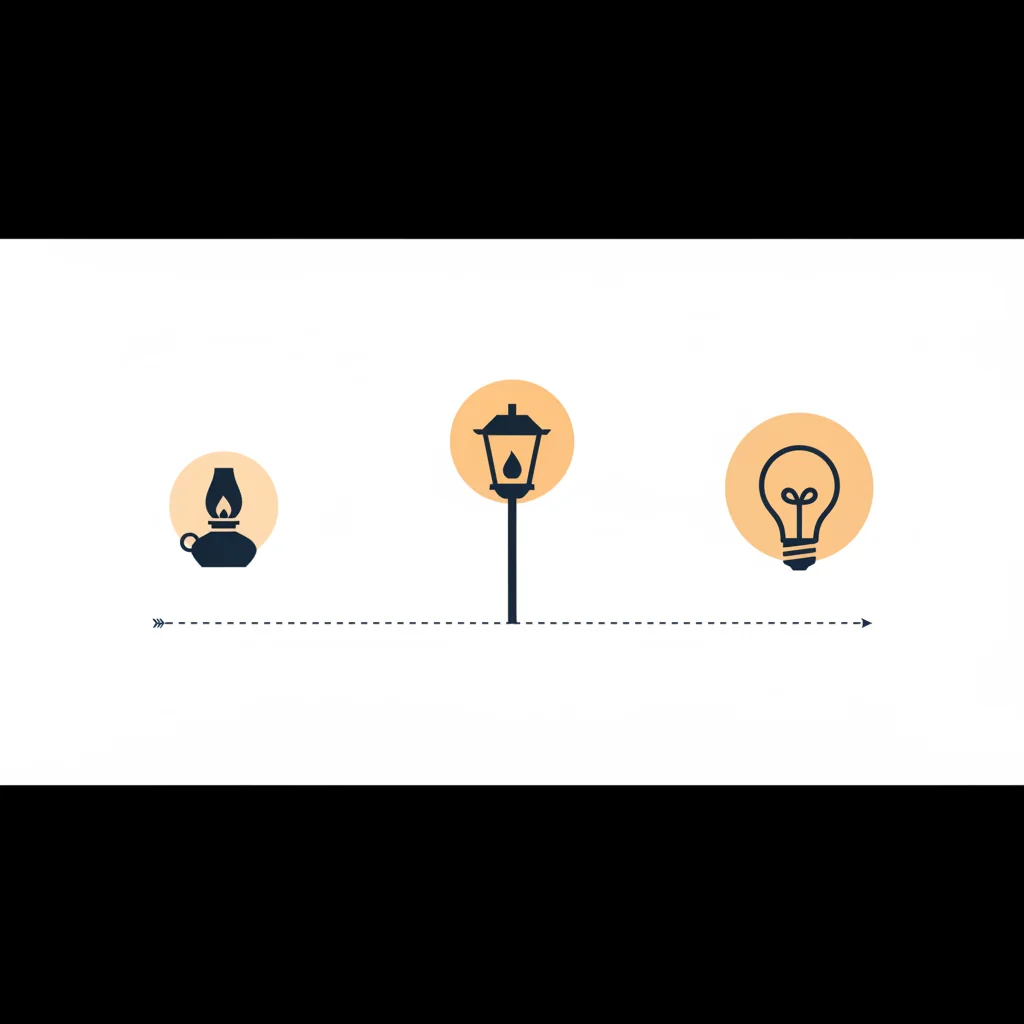
Until the end of the nineteenth century, someone walked through your street every evening to light the gas lamps. The lamplighter. He knew his route, knew which lamps needed maintenance, sensed when it was dark enough to start. It was craftsmanship, in its own way.
It wasn't the first version of that craftsmanship either. Street lighting went from candles to oil, from oil to gas. Each time, the profession adapted. Each time, the core stayed the same: streets needed to be lit.
Then came electricity, and it replaced the job entirely.
Gaslight was warmer, more human, more reliable. At least, in the eyes of those who knew it. The lamplighters saw their livelihood threatened by something they didn't understand and hadn't asked for. They'd been doing their job well for years. Why would that suddenly no longer be enough?
The lamplighters who refused to adapt disappeared. Gradually. The lamplighters who learned to work with electricity became electricians, street lighting technicians, grid operators. They came out ahead. The tool had changed, the purpose hadn't. The lights still got lit, just not with a match.
What I see on LinkedIn
In recent months, I've noticed a growing number of posts from people in closely related fields speaking out against AI. Without nuance, in the way we've increasingly come to expect from modern American-style debate on just about any topic.
AI makes mistakes and doesn't understand nuance. AI lacks the feel for language that a craftsman has. The most painful AI failures get pulled to the surface.
I get it. You've spent years investing in a skill. You've built a client base around it. And then a tool comes along that produces in thirty seconds what used to take you three hours. The quality isn't the same, that's true. But the gap in price and speed is so large that the trade-off shifts for many clients. That's frightening.
Some objections are also fair. If everyone uses the same AI tools for content, analysis and recommendations, everything starts to look the same. The output gets flatter. The distinctiveness disappears. That's not an unfounded fear, it's a real risk that I see myself. If you use AI without your own perspective, you produce mediocre copies of mediocre copies.
And it's moving fast. Three years ago we were laughing at AI-generated videos of Will Smith eating spaghetti. Unrecognisable, absurd, unusable. Today you can generate video that's indistinguishable from reality. It's that speed of improvement that makes it frightening. If you look at what AI tools can do today compared to two years ago, you have every right to wonder where this goes in another two.
But that's an argument for better use of AI. Not for refusal.
From pivot tables to Python
I use AI every day. As a work tool.
I used to spend most of my time building Excel spreadsheets. Pivot tables, helper columns, formulas on top of formulas to connect data and extract something useful. Trying to pull insights from data that was there but didn't readily show what we needed.
That worked, up to a point. But you always hit a wall with what Excel can handle.
When I started working with first ChatGPT and later Claude, that wall moved. I could make the same connections in Python scripts. Faster, more interactive, fundamentally more flexible. Work that took days in Excel was done in an afternoon.
A concrete example. I work for a client that manages farm stays across multiple European countries. To understand where their guests come from and how far they drive, I needed to translate postcodes into coordinates and project them onto a map. If we wanted to see this, we had to bring in an expensive tool that didn't even let us break it down by location or product. Or hire a developer.
With AI as copilot, I built that script myself. Today it's grown into a full dashboard combining booking data, marketing data, repeat behaviour and geographic spread, built on offline data with marketing data pulled from BigQuery, running entirely on Python.
This website and everything on it came together the same way. I wrote the articles, AI helped me structure, translate, and think through the content. The technical migration to a faster platform wouldn't have happened in that timeframe without it.
The foundation
In the 2025-2026 academic year, I started a programme in Applied AI at Howest. Statistics, Python, the fundamentals. After a few months I had to put it on hold when my second son was born.
I threw in the towel on the programme itself (temporarily?), but the foundation I picked up there made the difference. I was already strong with data, but the refresher in statistics gave me a better understanding of how data behaves, how to interpret results, and where the pitfalls are. Learning the basics of programming taught me how a script is built and when a result doesn't add up.
That's important to recognise, because it happens from time to time. AI gives me bad advice.
I catch those mistakes because I know the businesses I work with well. I know their history, their seasonal patterns, their customers. That's context no AI model has.
The model can compute faster. I spot the errors through what I know about the businesses involved.
That's the core of this whole story. AI lowers the barrier to execution. At the same time, it raises the importance of judgement. The tool makes you faster, and that doesn't automatically improve your judgement. That part still has to come from you. I wrote before about why marketing reports stay so simple. The same principle applies here: measuring without understanding rarely produces insight.
Where I'm headed
I have the ambition to grow my consultancy into a model where AI agents take over part of the operational work. Routine checks on campaign performance. Flagging changes in business data. Drafting email proposals. There are countless KPIs to monitor, and AI can spot patterns faster than I can.
I already have a Slack channel with an AI agent that sends me reports. But it's not good enough yet to deploy commercially. That could change quickly, of course.
There are a few reasons I prefer AI over hiring people. I struggle with delegating. I struggle with trusting that someone else will do the work the way I would.
Like people, AI makes mistakes. But AI has no problem with being pointed to its mistakes time and again.
On top of that, if I were to hire staff for the tasks I currently use AI for, the cost difference would be enormous.
With an AI agent I can review every output, adjust every process, check every result and improve the system over time. It's the first tool that lets me delegate without letting go.
Three groups
There are risks, of course. AI is going to contribute to the brainrot, the cognitive laziness, that's already being fuelled by social media. If you never have to think, your brain becomes a lazy muscle. If you turn to AI for everything without critically evaluating the output, are you the robot or is your LLM?
It remains, in my view, your own responsibility to stay critical.
The lamplighter who became an electrician still had to understand how electricity works. He didn't just blindly flick a switch. His job got 'easier', but the real value was in his expertise.
There are three groups. The refusers, who fall behind. The blind followers, who make mistakes faster. And the people who use the tool and understand what it does.
The refusers we've already covered. The blind followers are harder to spot, and therefore more dangerous.
- The copywriter who uses ChatGPT to generate text without understanding why certain sentences work and others don't produces no better work.
- The SEO specialist who lets AI write without grasping the search intent behind a query makes the same mistakes. Just faster.
- The analyst who lets AI crunch numbers without being able to interpret the result has a faster calculator and no better insight.
- The university rector who uses ChatGPT without review to deliver a speech and ends up citing fabricated quotes, risks reputational damage.
- The cook who photographs his piece of meat in the oven and asks ChatGPT how much longer it needs, will likely ruin his meal.
- The CEO who values Claude's advice over the expertise of employees who know the business inside and out risks losing his people.
Getting into the third group is quite simple: use AI, but never accept the output without understanding what's in it and editing it yourself where needed.
Eventually, the future will push most people towards that third group.
When you hire an agency or a consultant, that's the question you should be asking: do they understand what they're doing, whether they use AI or not. I wrote before about how to check if your agency is showing you the right numbers. The same honesty you expect about numbers, you should also expect about how the work gets done.
AI is so 'trendy' right now that some companies can't help mentioning it twenty times over and capitalising on the hype.
Yes, I recognise the irony of that last sentence in this article.
The voice in your head
I read De Tijd every day. It sometimes surprises me how much further along certain companies are with AI than I am. A little voice in my head tells me I'm not doing well enough, that I need to move faster.
If you read my earlier article on imposter syndrome, you'll recognise that voice. But you don't need to have read it to recognise the stress that comes with the arrival and evolution of AI.
That stress wears you out. The emotional response is fear, resentment and distrust.
But that same stress also keeps you sharp. It pushes you to try something tomorrow that you can't do today.
In China, AI use is mainstream. It's actively encouraged by the government and deployed at scale by businesses. In Europe, we're occupied with discussions about privacy, regulation, and our dependence on American models. Rightly so, because right now we have no fully-fledged European equivalent to ChatGPT or Claude. Mistral from France comes closest, but the dominance is American. And while we debate, the gap grows wider.
If I don't keep learning, I'll be overtaken by someone who did. And thanks to language models, I may soon be competing for local marketing work with someone on the other side of the world.
I understand that AI can be frightening. That your profession feels threatened by something you don't fully understand or trust. That feeling is human, and it's valid.
But the street still needs to be lit.