TL;DR: Google Ads reports all conversions after a click, including those that would have happened without the ad. Of 1000 reported conversions, perhaps only 500 are incremental. Branded search as an example. Test it yourself: turn off that campaign for 2 weeks.
Reading time: about 8 minutes.
Imagine your marketing agency tells you their latest Google Ads campaign delivered 1000 conversions. Good news. The campaign costs 40,000 euros, so your cost per acquisition is 40 euros. At an average customer value of 200 euros, this looks like a profitable campaign. But does this match reality?
I can already hear you thinking "yes, of course not every conversion is a sale". Sometimes a contact request or checkout start also counts as a conversion. That would be a valid remark, were it not for the fact that it is not what I am talking about here. This is not about the wrong type of conversion, or about miscounting. What I want to point out is that "1000 conversions attributed to this campaign" means something different from "1000 people bought solely because of this campaign." There is an important distinction between those two sentences.
This article is about that difference. About why it exists, what it means for your decisions, and why it is rare for someone to tell you about it explicitly. As I wrote in my previous article, most agencies work at level one: reporting what platforms say, without adding context.
Why do platform-reported ad numbers rarely add up to actual business results?
Because an ad platform counts every conversion that follows a click, including purchases that would have happened without the ad. Your business results only grow with the part the ads themselves caused, and that part is smaller than what the platform reports.
What a platform counts
When Google Ads reports that a campaign had 1000 conversions, it means this: 1000 people made a conversion within the attribution window after clicking an ad. There is nothing inherently wrong with this measurement, and it is one of the things I look at to see whether my campaigns are running well. But it is not everything you want to know.
Because within those 1000 converting users there are three different groups that Google Ads cannot distinguish:
| User type | What happened | Incremental? |
|---|---|---|
| Would buy anyway | Searched for brand name, clicked ad instead of organic result below. Bought either way. | ❌ No |
| Convinced by ad | Still hesitating, ad pushed them over the line. Without ad: no purchase. | ✅ Yes |
| Accelerated/shifted | Would buy later or via other channel, now came in faster. Timing shifted, not necessarily new. | 🟡 Partially |
These three groups are reported in Google Ads as the same "conversion." They sit next to each other in the same number. The platform does not know which group someone belongs to, because it simply does not have the data to distinguish.
Of the 1000 conversions you get reported, perhaps only 500 are truly incremental. Then your real cost per acquisition is 80 euros, double that. At a customer value of 200 euros there is still margin, but much less than the report suggests. If the ratio is closer to 300 out of 1000, it becomes 133 euros CPA and the campaign becomes loss-making. How skewed the ratio is, you do not know from a standard report. You do know that the chance is high that it is skewed.
The campaign I'm most careful with
There is one type of campaign where the difference between reported and incremental can be the largest: paid branded search. These are ads on searches for your own brand name. In reports they look spectacular, with a low cost per click and a high ROAS. On paper it is the best channel in your entire marketing mix. At the same time, it also gives the most distorted picture, and it's an easy way to score.
The reason is simple. People who search for your brand name have already chosen your business. They type in your name and click your ad, which sits above the organic results. Without the ad, many of them would have clicked one centimetre lower on your organic result and done the same thing.
That's why I only switch on branded search with reservations, when there's a reason for it. If competitors or resellers bid on your brand name, you want to be at the top yourself. A brand campaign can also make sense when you want to control which message and which landing page someone sees, for example during a promotion.
How much it adds varies a lot from business to business. It depends on your price position against whoever bids on your name, and on how exclusive your offer is. If your offer is unique and you're the best value yourself, a searcher will probably reach you without the ad. If others sell the same thing, sometimes cheaper, your ad can make the difference. If you want to know what it adds for you, you can pause it for a while in part of your regions and compare with the rest, using a holdout test.
Because the reporting itself doesn't make that distinction. Google Ads reports every conversion on your brand name as if the ad caused the purchase, whether you're running defensively against a competitor or intercepting someone who was coming to you anyway.
I have had clients who sensed this before they worked with me. One client put it this way: "Google Ads is rigged, because most visitors just come in on your brand name and then the agency takes the credit." He had no background in marketing analytics. He saw it happening in his own numbers.
That makes branded search a good test for an agency that reports honestly. An agency that reports branded search separately from your other Google Ads campaigns, and explains why those numbers need to be read differently, deserves your trust. An agency that lumps everything together and is proud of the total ROAS deserves a follow-up question.
How you can test this on your own campaign
You do not have to take my word for it. For a branded search campaign, you can test incrementality yourself with one simple experiment: turn off the campaign for two weeks. Then measure two things.
First: what happens to your organic traffic on your brand name? Have a quick look in Search Console. If your CTR and clicks suddenly go up, you already know. Do you also see a shift from last-click conversions toward your organic channels? Then you have two pieces of evidence.
If your revenue and organic conversions largely stay on track, you know what you need to know. The campaign was mainly filling the report, not the business. If your revenue does drop measurably, the campaign does have incremental value. Maybe because competitors bid on your brand name and you lost traffic without the ad. Maybe because your promotion message in the ad won clicks that the organic result did not get. In that case you also know what you need to know: the campaign earns its place.
Results vary, and that is the point. In my own client work I have seen both outcomes. Companies where pausing branded search had barely any effect on actual revenue, and companies where it was significant. The answer is not universal. It is specific to your business, your competitive environment, your brand. Neither outcome is a verdict against your agency. Both give you harder material than a platform report can ever provide.
It is an experiment that requires no PhD. Only the willingness to take a small risk that the numbers might drop slightly for two weeks. Check the auction insights to see how much competition there is for your brand name.
One of my clients, by the way, was firmly convinced that brand searches only happened from repeat customers, because they already knew the brand. But he was making the mistake more clients make: thinking that brand searchers are by definition existing customers, while awareness campaigns have exactly the goal of creating those brand searchers. New people who learn about your brand will also search for your brand name. Without having converted with you yet.
What you can do as a client besides this
Two other things you can do. First: ask your agency to report branded search separately from other Google Ads campaigns. The numbers from branded search need to be read differently from those of campaigns that try to spark new interest. If your agency refuses or downplays this split, you have an answer to a question you had not yet asked.
Second: put reported conversions next to your own revenue data over the same period. If the platform says you had 30 percent more conversions, but your total revenue only went up 5 percent, where did those extra conversions come from? Often the answer is that they were already in your pipeline, but are now attributed to a campaign that did not cause them. A sharper question alongside this: how many of those conversions were new customers, and how many were existing customers who would have bought anyway? Your own revenue ledger is the best incrementality signal you have available for free.
Bringing all data together in one place
The sharpest way to see incrementality is by connecting all business data. From first ad click to conversion, from first purchase to repeat. Google Ads only sees its own piece, your CRM only sees customers, your accounting only sees revenue. You want to see them all connected rather than guessing.
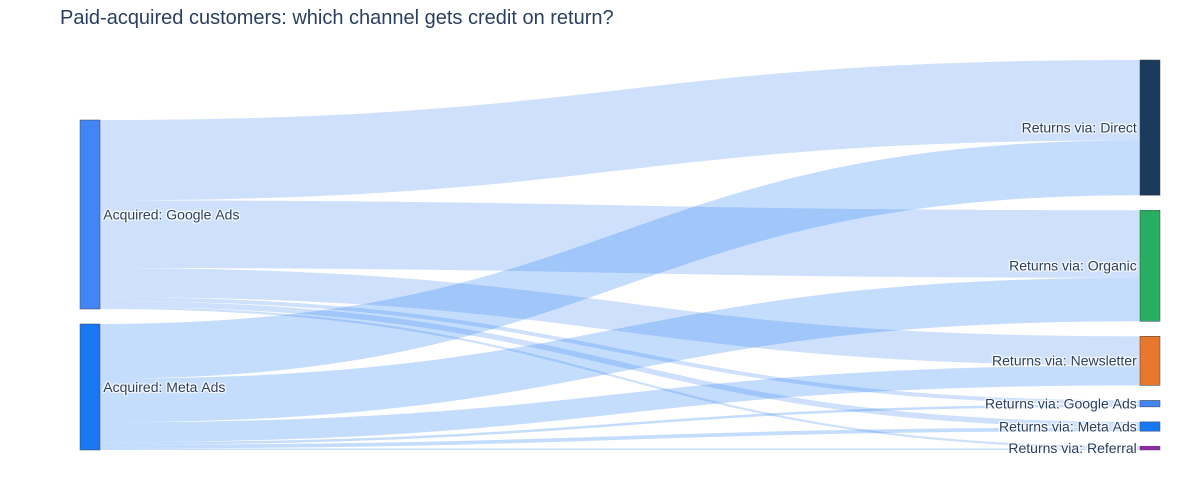
In my work I build dashboards that bring these sources together using AI, BigQuery, Supabase and other tools. This can now be done without months of development work. You then see for the first time which campaigns bring new customers versus activate existing customers. Which channels lead to repeat customers. Which investments grow.
That is level two I wrote about in my previous article. For that, you mainly need context about your own business.
How does it stand
The search for incrementality is a difficult story. For platforms it undermines their sales story. For agencies it makes their reports harder to defend. For clients it means the numbers on which they base budget decisions can be misinterpreted. You can measure so much in digital marketing that it is hard to accept that some numbers have a blind spot. And because precisely that makes it complex, it gets ignored as long as no questions are asked about it.
An agency that is transparent about what reports do and do not say delivers something that should be the standard in this industry, even if it isn't yet. An agency that presents reported ROAS as if it were actual ROAS, does something that is understandable for them, because it keeps the story simple and their position defensible. The client pays the bill without knowing it.
What you can do as a client is not validate every campaign with experiments. That is unrealistic. What you can do is look differently at the numbers that come to your desk. With the question in the back of your mind: what part of this is real, and what part is noise presenting itself as result? That has nothing to do with distrust, by the way, or with manipulation of the numbers. Rather with getting a complete picture.
In a follow-up article I go deeper into POAS versus ROAS and what becomes visible when you include profit per acquisition rather than only revenue.