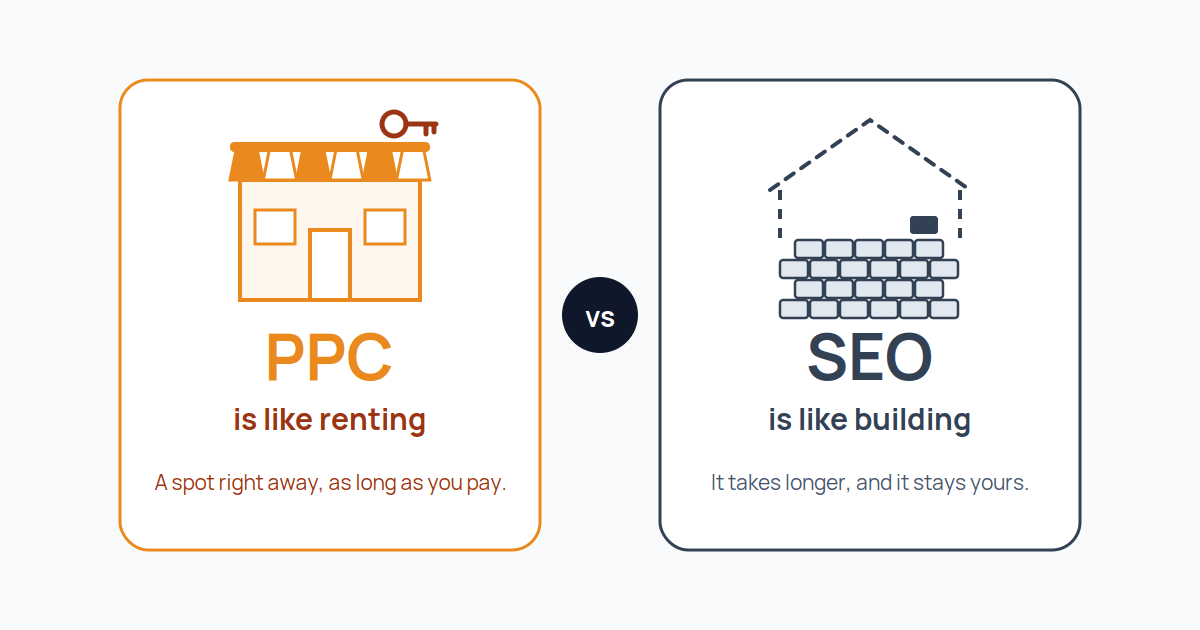
You want your business at the top when someone searches for what you do. There are two ways to get there. You can pay to be at the top, or you can work on your website so Google ranks it higher in the normal results. The first is called PPC, the second SEO.
PPC is a bit like renting a shop: you're there straight away, as long as you pay. SEO is building your own: it takes longer, and what you build stays yours. In both cases, you're still responsible for the upkeep.
Both have their place, and they work best together. To see why, start with what someone sees when they search.
What does a search results page look like?
Type "bathroom renovation cambridge" into Google. At the top you'll see a few results marked "Sponsored". Those are ads. For a search that includes a place name, a map with local businesses can follow. Those come from their Google Business Profile. Only below that do you get the normal results, which Google ranks itself.
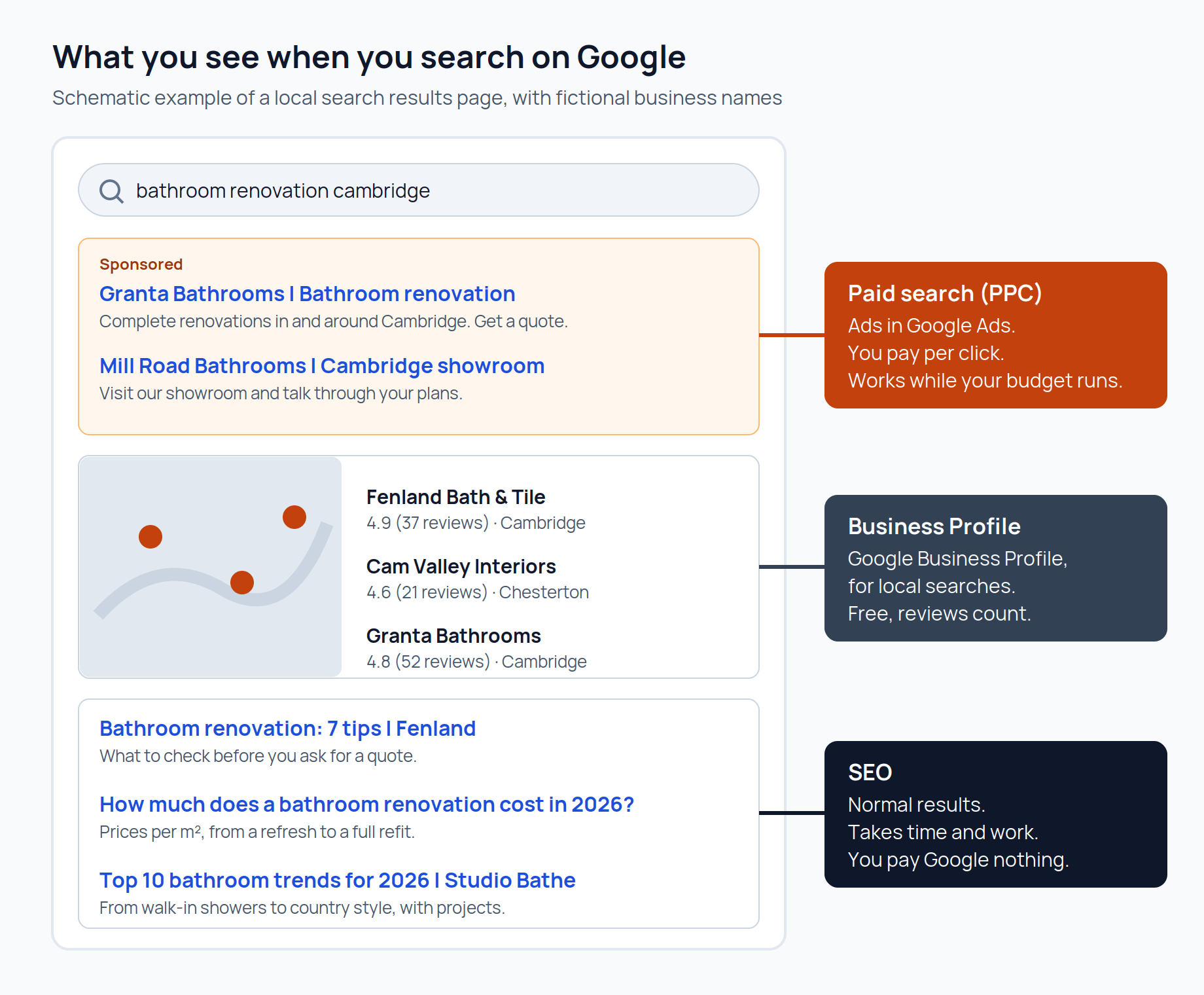
For a place in the top block, you pay. The map and the normal results cost you nothing at Google. There, you 'earn' your place.
What is PPC, or paid search?
PPC stands for pay-per-click. Strictly speaking, that covers every ad you pay per click for, including ads on Facebook or LinkedIn. In this article I mean paid search: ads in a search engine. In Belgium and the Netherlands that's called SEA, search engine advertising. That means Google Ads, and to a lesser extent Microsoft Ads for Bing.
You choose which searches your ad appears for, and you only pay when someone clicks. What a click costs depends on how many other businesses bid on the same keyword, and on how well your ad and your page match the search.
The big advantage of PPC is speed. From the day your campaign goes live, you can in principle be at the top. You also see quickly what it brings in, because you know what you spent and how many customers came from it.
The downside is that it stops when your budget stops. Switch the campaign off, and you disappear from the top block that same day.
What is SEO (search engine optimisation)?
SEO stands for search engine optimisation. You work on your website so Google ranks it higher in the normal results.
Google asks itself two questions. How well does this page match a specific search? And does Google trust the site enough to put it at the top?
For the first question, what's on your page counts. A page about "bathroom renovation", with those words in the title and the text, stands a better chance than a general page called "our projects". Trust builds over time, and with other websites linking to yours. On top of that, your site needs to be technically sound, fast and easy to read on a phone.
Is SEO free?
You pay Google nothing per click, so SEO looks free. "Organic" also sounds like "it happens by itself". Unfortunately, that's not always the case.
The biggest cost of SEO is time. Writing and updating content takes time, and so does getting your site technically right and keeping it that way. If you outsource it, you pay for it in hours. SEO takes more work and time than PPC.
On top of that, there's less certainty. SEO isn't an exact science. It's more a set of rules that give you a better chance of ranking well.
You can work on a page for months without it moving up, because your competitors are working on their sites too, and Google changes how it ranks pages regularly.
However much you work on SEO, you'll never have a 100% chance or guarantee of the top spot for keywords where there's already competition. You can rank well one day and be gone the next.
With PPC, you know sooner where you stand.
Even so, SEO is always worth trying. You can keep working on it, and what you build stays in place when you stop paying. What I mean is that SEO is never wasted work (if you do it properly).
Here's an example to illustrate. A bathroom specialist wants more enquiries for bathroom renovations. An average job is worth €10,000 to him.
With PPC he can appear for all his keywords from day one, from "bathroom fitters" to "bathroom renovation cost". The condition is that he has a matching page for each of those keywords. He chooses how much to spend, and sets €20 a day, about €600 a month. At €6 a click, that brings in roughly 100 visitors a month, from the first week. On top of that comes work. Setting up the account and the tracking takes time. After that comes the ongoing adjusting.
With SEO he works per group of keywords. He has four pages written, each on one topic. Think of bathroom renovation, the cost of a renovation, a walk-in shower and bathroom renovation in Cambridge. Each page takes six hours of work, and then three hours a month to keep them all up to date. For SEO he pays Google nothing. He puts the content on the site himself, or gives his consultant access to his website.
| PPC | SEO | |
|---|---|---|
| Ad budget per month | €600 | €0 |
| Work in the first month | About 10 hours in this example (setup) | About 24 hours in this example (four pages) |
| Work per month after that | About 3 hours in this example (adjusting) | About 3 hours in this example (maintenance) |
| Keywords covered | Every keyword you have a matching page for | The four topics of your pages |
| Visitors per month | About 100, from the first week | About 80, from the fourth month, if the pages rise |
| Enquiries per month (3% of visitors) | About 3 | About 2 to 3, from the fourth month |
| Customers (1 in 4 enquiries) | About 3 every four months | About 1 every two months, from the fourth month |
| After six months | €3,600 budget, about 25 hours of work, 4 to 5 customers | About 39 hours of work, 1 to 2 customers |
| If you stop paying | Visitors stop immediately | The pages keep bringing visitors |
Fictional figures. Not applicable to every case and purely for illustration.
In this example, PPC brings in 4 to 5 customers in six months, worth €40,000 to €50,000 in jobs. Even after the ad budget and the hours, a good part of that remains, although your profit depends on your own margin. SEO brings in less in those first six months. On the other hand, those four pages keep working afterwards, with no budget per click. If they don't rise, you've lost the hours without a single extra visitor.
What you earn from it depends on your own numbers. How much is a customer worth to you? And how many of your visitors end up as customers? Those are useful to know if you want to build an efficient campaign. If you don't know them yet, you can of course work out how much budget you can spare for extra volume, and simply start with that.
You choose your PPC budget yourself, by the way. You can start with €5 a day or with €100 a day, and you can change it or pause it any day. Sometimes a lower budget will limit your campaigns, but sometimes a higher budget won't give your campaigns more room either. It all depends on search volumes.
Pros and cons of PPC and SEO
| PPC | SEO | |
|---|---|---|
| Speed | Visible from day one | Results after months |
| Certainty | You quickly know what it brings in | No guarantee your work pays off |
| Cost | Every click costs money, as long as you advertise | You pay in time and work |
| If you stop | You disappear immediately | What you built stays in place |
| Control | You choose your keywords and your budget | Google decides where you rank |
| Outsourcing | An external partner can do almost everything for you | You have to work on your site yourself |
With PPC, an external partner can do almost everything for you, from setup to daily adjustments. It does help if you brief them yourself: who your ideal customer is, what you'd most like to sell, what you don't want to be found for, … But you'll rarely have work on it yourself, apart from following up the enquiries that come in.
With SEO, an external partner can deliver good content and a list of improvements. To get them onto your site, you have to give them access to your website, or get to work on it yourself. Part of the work stays with you or your web developer.
Why isn't your website showing on Google, and what can you do yourself?
Before you spend money on SEO, there are a few things you can check yourself. They take little time, and sometimes they already solve the problem.
Is your page in Google?
A page Google doesn't know can't appear anywhere. Type "site:" followed by your domain name into Google, for example "site:yourbusiness.co.uk". You'll see roughly which pages of your site Google knows. If an important page is missing, connect your site to Google Search Console. It's free. You can check page by page whether it's in Google, and ask Google to add it if it isn't. You'll probably need your web developer to get access to Google Search Console.
Do you have a page about what people search for?
Google shows a page that matches the search. If you put all your services on one page, it won't match any search well. A bathroom specialist is better off with a separate page for bathroom renovation, with "bathroom renovation" in the title and the main heading of the page.
Do your other pages link to it?
A link from your homepage or from an article tells Google which page matters. Use the words you want to be found for in that link, such as "bathroom renovation in Cambridge". A link that says "click here" tells Google nothing.
Is your Google Business Profile in order?
If you work locally, your Business Profile helps decide whether you appear on the map. Choose the right category and fill in your service area. Add a link to your website as well. Ask happy customers for a review.
Once you've done all that, waiting is part of the work. A new or updated page only rises after weeks or months.
Where do SEO and PPC fit in your marketing funnel?
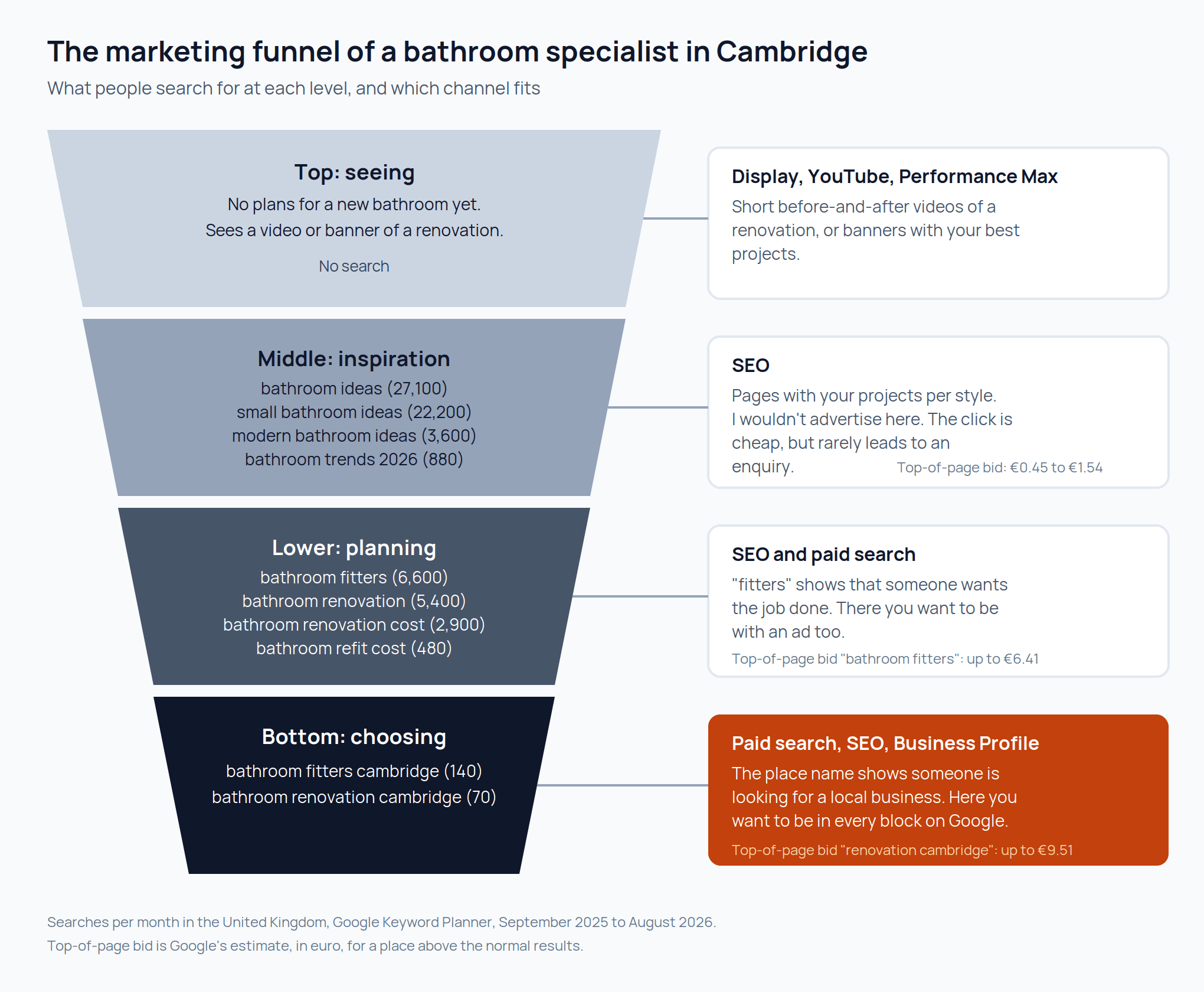
A marketing funnel shows the path someone takes from "I don't know you" to "I'm a customer". The lower in the funnel, the closer someone is to buying. Each channel has its place in it. Let's stay with the example of a bathroom specialist, this time in Cambridge, and I'll also be honest about what helps my own website.
Top: someone sees you before they search
At the top, nobody is searching yet. Someone is watching YouTube or reading a news site, and sees a video or a banner of a beautifully renovated bathroom. That's the territory of Display and YouTube campaigns. Performance Max, the Google campaign type that bundles its channels, plays a part here too, as it does on the lower levels.
For my own business, this level is less relevant.
Middle: someone is looking for inspiration
A little later, the same person searches for "bathroom ideas" (27,100 searches a month in the UK) or "modern bathroom ideas" (3,600). You'll see more in the funnel above. That person is still dreaming. They want to see photos, and asking for a quote comes later.
I wouldn't buy ads for those keywords. A click costs little, but the chance that someone gets in touch straight away is small. For SEO they're interesting. A page with your projects per style, or an article like "Top 10 bathroom trends for 2026", brings those people to your site, well before they look for a specialist.
Tip: for this kind of landing page, it works well to have something that collects leads. For the bathroom specialist, for example, a downloadable brochure with bathroom trends, in exchange for an email address and/or phone number.
Lower: someone is planning a renovation
"Bathroom renovation" is a big search term, with 5,400 searches a month in the UK. There's still a lot of doubt in it, though. Some of those people want to do it themselves, others want to know what it costs. "Bathroom renovation cost" gets 2,900, "bathroom refit cost" 480.
Here, one word makes the difference: "fitters". Someone searching for "bathroom fitters" (6,600 a month) has already decided that someone else will do the job. You can see that in what advertisers are willing to pay. Google estimates a bid of up to €6.41 per click for a place at the top, against €0.45 to €1.54 for "bathroom ideas". Here, PPC and SEO both work. But the higher the intent, the harder it is to rank well in SEO, and the more expensive it gets in PPC.
Bottom: someone chooses who will do it
At the very bottom, the place name comes in. "Bathroom fitters cambridge" (140 a month) and "bathroom renovation cambridge" (70) come from people looking for a business near them. For "bathroom renovation cambridge", Google estimates a bid of up to €9.51 per click. These people are comparing just a few names, and the chance that they call is high. This is where you want to be visible in every block of the results page, including the map with your Business Profile.
In Google's figures, "bathroom specialist cambridge" doesn't even appear. Hardly anyone types it that specifically.
High and medium intent: an example from my own work
You see the same pattern with the keywords for my own kind of work. In the UK, "freelance marketing consultant" is searched 170 times a month, and "freelance marketer" 50 times. Some of those people want to become a freelancer themselves or are looking for work. The intent is mixed.
Add a town, and someone is probably looking for help nearby, so the intent is higher. Only, hardly anyone searches like that: "marketing consultant cambridge" gets 20 searches a month. The combination with a town that people do search for is "marketing agency cambridge" (210 a month). That's someone looking for a partner nearby and ready to get in touch.
My own market is Belgium, where people search in Dutch, and it works the same way there. "Marketing freelancer" gets 210 searches a month, with mixed intent. With "brugge" (Bruges) added, almost nobody searches, while "marketingbureau brugge" (marketing agency Bruges) gets 90. For that search I have a dedicated page: online marketing in Bruges (in Dutch).
Keywords with mixed intent, like "marketing freelancer", I keep a close eye on in Google Ads, with exclusions for jobs and training. Keywords with high intent, like "google ads uitbesteden" (outsource Google Ads) and "marketingbureau brugge", I definitely want to reach with an ad as well.
Two objections to PPC
"People don't search for my business or my product anyway"
Sometimes that's true. Nobody searches for a new product or an unknown brand by name. They search for their problem or their wish, like "bathroom ideas" or "bathroom fitters". That's where you catch them, with SEO in the middle of the funnel and with PPC lower down. People who don't know your product yet are easier to reach with Display or YouTube than with search. It's almost always worth looking at what paid social ads, such as ads on Facebook, Instagram or LinkedIn, can do for you here too.
"People already search for my name, so I don't need PPC"
That's sometimes true as well. If your site is at the top for your own name and no competitor bids on it, an ad adds little. If competitors do bid on your name, they appear above you, and an ad on your own name can keep the customer with you. It depends on your situation, and you can test it. How to do that, you can read in my article on Google Ads reports.
What AI Overviews change
For many searches, there's now an AI Overview from Google at the top: a summary that answers the question straight away, with a few sources attached. For the person searching, that's handy. For you as a business, it means fewer clicks.
Pew Research followed almost 69,000 real searches by 900 Americans in March 2025. When an AI Overview appeared, people clicked a normal result in 8% of cases. Without an AI Overview, that was 15%. Ahrefs measured in December 2025, across 300,000 keywords, that the page in first place gets 58% fewer clicks when an AI Overview sits above it.
It mainly affects informational questions, such as "what is seo". There, Google answers the question itself. For a search like "bathroom fitters cambridge", someone is looking for a business, and not for an explanation.
There's another side too. According to Seer Interactive, businesses cited as a source in an AI Overview get 35% more organic clicks than businesses that aren't. So your site can appear in that overview itself. My own site has appeared in it now and then since September, mostly with my services page and two English articles.
For SEO, that means: write pages that answer a question clearly and completely, so Google picks them as a source. For PPC, it means ads on informational questions bring in even less. Ads also get fewer clicks when an AI Overview is shown. So your budget is better spent on keywords with high intent.
Do you need to be in first place?
Nobody can promise you first place. In SEO, Google decides, and your competitors are working on their sites too. In PPC, an auction decides who comes out on top for each search, and your position moves with what others bid.
First place does get the most clicks. Advanced Web Ranking tracks this every month across millions of search results in the United States. In July 2026, the first normal result got an average of 20% of clicks on desktop, and the second 10%. From third place, it drops below 4%. If there's an AI Overview from Google above it, first place drops to about 10% (Advanced Web Ranking, CTR study 2026). These are averages, of course, and they won't apply to every case.
Clicks aren't customers, though. In PPC you need the highest score in the auction for first place, and that usually costs more per click, unless your ad or landing page is simply much better. Google once researched whether ads at the top convert better, and found hardly any difference. An ad that converts 1% of clicks in first place converts about 0.95% on average in the lowest position. To be fair, that research is from 2009, but it does tell you something.
So pick your battles. For "bathroom renovation", with 5,400 searches and competition from across the UK, a local business will struggle to reach the top. For "bathroom renovation cambridge" you stand a much better chance, and that searcher is closer to an enquiry. In PPC, decide up front what a customer may cost you, and only then look at your position.
SEO and PPC go together
In principle, you don't have to choose, because both are essential.
With PPC you capture keywords with high intent faster and more efficiently. You're there from the first week, and you only pay for the people who click. Meanwhile, you build up your organic rankings with SEO. Once a page ranks well in the normal results, you can turn down PPC for those keywords.
I'd never drop PPC completely if your budget allows it. An organic ranking is never guaranteed, and it can drop from one month to the next. Ads sit above the normal results, and competitors can bid on your keywords. If you launch a new service, or want extra visibility in a busy period, PPC is the only way to be at the top straight away.
A good landing page helps both. Google ranks a page that clearly answers a search higher in the normal results. The same page gives your ads a better Quality Score, so you pay less per click.
Your search terms in Google Ads show what questions people ask, and that's material for your SEO content. This article partly comes from that too. In my own search terms, "website niet zichtbaar op google" (website not showing on Google) came up.
The intent behind a keyword decides where you put your focus. If someone wants to know something, you reach them organically. If someone wants to buy something or have something done, you reach them with an ad as well.
I apply this myself. I removed informational keywords, such as "google advertenties" (Google ads), from my Google Ads, and I try to win them organically, partly with this article. On my services page I made the title and the main heading match the search "online marketing uitbesteden" (outsource online marketing; the page is in Dutch). Within a few days, that page ranked first for it on Google. A week later it had lost that place again. That's exactly what I mean above: a ranking is never guaranteed.
Is Google Ads something for your business? Would you like someone to set up and manage your Google Ads, or to look at what's worth it for you? Read how I manage Google Ads for you.
In short
- PPC is advertising on Google. You pay per click, and it works as long as your budget runs.
- SEO is working on your site so Google ranks it higher. It takes time and work, even though you pay Google nothing per click, and the result is less certain.
- With PPC you choose your budget yourself, and an external partner can do almost everything for you. With SEO you have to work on your site yourself.
- PPC captures keywords with high intent fastest. As your SEO grows, you can turn PPC down, but I wouldn't go without it entirely.
- Inspiration keywords are for SEO. Keywords like "fitters" or with a place name are for SEO and PPC together.
- A good landing page helps your Google ranking and your Quality Score in Google Ads.
- Google's AI Overviews mean fewer clicks on informational questions. Clear answers on your pages give you the chance to be cited as a source yourself.
- If your site isn't showing, first check whether your pages are in Google, and whether there's a page per service.
- Nobody can promise you first place, and it isn't a goal in itself. Pick keywords where you stand a chance and that bring in customers.
Test yourself
1. You're a bathroom specialist. Do you buy ads for "modern bathroom ideas"?
Better not. That searcher wants inspiration. With an article full of examples and photos of your projects, you win them organically.
2. Why does "bathroom fitters" have higher intent than "bathroom renovation"?
The word "fitters" shows that someone wants someone else to do the job.
3. Is SEO free?
You pay Google nothing per click. It costs you time and work, and the result is less certain than with PPC.
4. Why does a better landing page also help your Google Ads?
Google gives your ad a higher Quality Score, and then you pay less per click.
5. How do you check whether your page is in Google?
Type "site:" followed by your domain name into Google, or look the page up in Google Search Console.
6. Do you always need to be in first place with PPC?
No. First place gets the most clicks, but also costs the most per click. Look first at what a customer costs you.